By Adam Mills
Jim Dandy Stakes Presented By Mohegan Sun (Grade 2)
Both Renegade and Commandment were sent off at single-figure odds for the Kentucky Derby in May. It didn’t quite work out for either of them on that occasion, though Renegade may well have been considered to be an unlucky loser at the time, and Golden Tempo has certainly advertised the strength of that form in the interim period. However, both were on a retrieval mission for their three-year-old seasons in the Jim Dandy Stakes at Saratoga on Saturday, and in their own way, both emerged with their reputations intact, if not fully restored. Renegade recorded a reasonable time when compared to other recent winners of the Jim Dandy, clocking 1:49.08, which has only been surpassed by Epicenter (2022) and Mystic Guide (2020) in the last decade, but there is something slightly unusual about his victory.
It’s a rare occurrence to see a race on the dirt won by a horse with a finishing speed of 101.7%. If we look at the other dirt races run on the same card, the winners crossed the line with finishing speeds of 94%, 96%, 95.7%, 93.3% and 96.2%. In my time writing for Total Performance Data, this is an extremely rare event, and yet Renegade has managed to record a finishing speed of 101.7% and make up a considerable amount of ground in the process to do so.
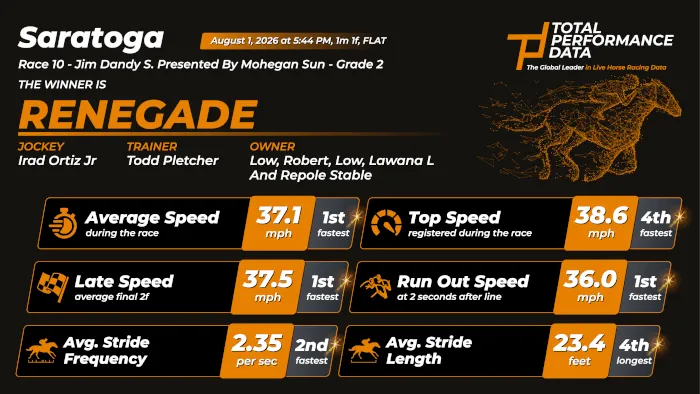
When I watched the replay for the first time, I assumed that I would be writing a piece explaining how the leaders had been committed for the line too early in the race, and as such Irad Ortiz had ridden the winner to pick up the pieces when they tired. To a certain point, that is still the case. Renegade closed with furlong splits of 11.82s and 11.97s, 0.69s quicker than Commandment over the closing quarter of a mile, while his late-speed figure of 37.54mph was a clear best of the five runners.
However, with the early pace set by Chip Honcho, the leaders reached the four-furlong pole in 59.94s, at a relatively-sedate 11.99s per-furlong pace. To give an idea of the difference that represents, in the three-year-old allowance race won by Sassmaster earlier on the card, the leader was at the four-furlong pole in 59.07s - almost a second ahead. A steady pace is not that unusual in the Jim Dandy, which tends to attract a smaller field, and the finishing speeds of the most recent winners in Sovereignty (98.6%) and Fierceness (95.9%) are slightly above average for a Graded race on the dirt. However, to give a horse like Commandment a head start of over a second and still run him down over the final half-mile, when he still had energy left in the tank, took an enormous effort, and those final three furlongs are easily the best performance of Renegade’s career as a result. At an average of 23.36ft, he had one of the shorter strides in the field, and as the in-race metrics graphic above shows, his top-speed figure of 38.6mph was only fourth best.
So, how did this shorter-striding colt manage to run down Commandment from a less-than-ideal position? The answer lies with the consistency of his stride. For each of the final four furlongs, Renegade had the highest average stride frequency figure in the field. Given the way that he finished the race, that’s not overly-shocking news, but with a stride frequency above his race average for the final half-mile, and more importantly on an upward curve for three consecutive furlongs, the momentum that he built from the crown of the final bend became relentless. He didn’t lengthen his stride in the manner that might be expected for a dirt winner. This was a case of a horse who is capable of charging at the line, moving his legs faster and faster as he clocked an average speed of 37.54mph for the final quarter of a mile.
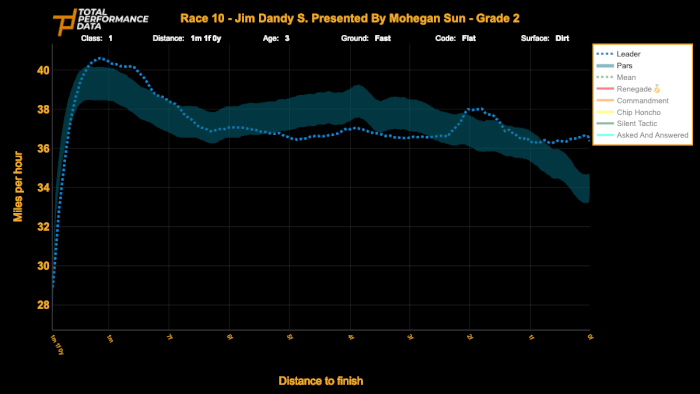
I have included the pace chart for this race above, with the blue line representing the winner’s pace, and as you can see, while there is a key point of acceleration at the top of the straight, Renegade is able to gallop on and maintain the fast pace for longer than his rivals. Commandment lost very little in defeat, but in a small-field race where the emphasis shifts to speed, he was found wanting by a horse who is capable of running at top speed for a longer-than-average period of time.
This was the perfect set-up for a horse like Renegade. A smaller field and the ability to use his tactical speed to best effect saw him return to the winner’s enclosure. Todd Pletcher has had a very successful season with this son of Into Mischief, but our data does confirm my view that it is not coincidence that has seen him win three races with finishing speeds of above 100%. He’s a compact colt who can reach his top speed and sustain that gallop for a longer-than-average period of time.
However, at the highest level on the dirt, that speed can only sustain a horse so far, and he will continue to be vulnerable to the true stayers that can lengthen their strides as well as quicken. In both the Kentucky Derby and the Belmont Stakes, his peak average stride length figures were over 2ft shorter than Golden Tempo, with Renegade simply unable to move his feet fast enough to account for that difference. Renegade is a very good horse, but despite the remarkable way in which he won this year’s Jim Dandy, I do think that he will continue to remain vulnerable to the likes of Golden Tempo, who can always lengthen past him. There will be lots of similar opportunities to the Jim Dandy Stakes to be won with him, but I think there will be others with far stronger claims in the Grade 1 races over this trip later in the year.
You can find sectional times, stride data, speed statistics and jumping performance metrics on the RESULTS page of attheraces.com.
The global database of sectional times, stride data and performance metrics is available through Total Performance Data.