There are few places in British racing where it is easier to believe that all is well than the sale ring at Tattersalls during Book 1.
On Tuesday, a Night Of Thunder colt changed hands for 4.6 million guineas, a new European record for a yearling colt. By the end of the opening session, 46.8 million guineas had been spent, turnover was up 16% on last year and the median price had reached 240,000gns. Stand beside the ring as Sheikh Mohammed and the other great powers of international bloodstock trade seven-figure bids and it would be entirely reasonable to conclude that this is an industry awash with money. Sadly, that is profoundly misleading.
Away from the cream of Book 1, the economics of producing a thoroughbred in Britain have become increasingly grim. The Thoroughbred Breeders’ Association’s 2023 economic impact study, undertaken by PwC, found the median yearling sale was generating a loss of around £33,000. The TBA has said that three out of every four yearlings sold in 2024 failed to recover their costs. The same study warned that profitability problems were particularly acute in the middle and lower parts of the market, where smaller breeders were already leaving the industry. Both realities are simultaneously coexisting.
British breeders continue to produce some of the most desirable thoroughbreds on earth, and there is ferocious international competition for the very best of them. That does not mean that producing the ordinary yearling is profitable. Indeed, figures presented to European breeders last year showed that 40% of gross expenditure was concentrated on just 5% of yearlings offered. 25 buyers accounted for 60% of purchases. Book 1 is racing's shop window. It should not be mistaken for its balance sheet.
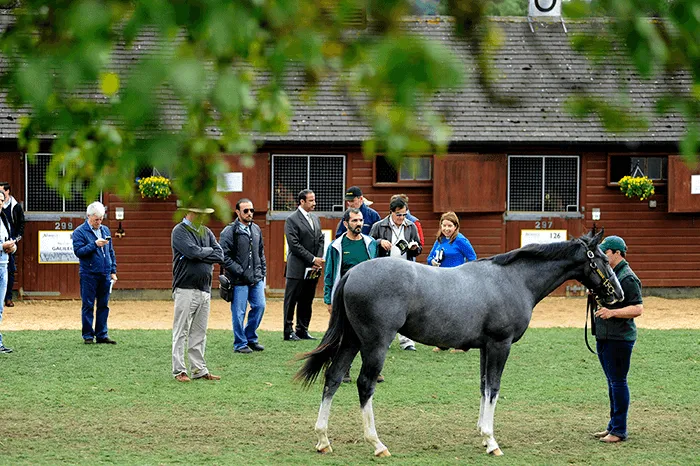
Beyond the sheltered sales ring of Newmarket, racing is currently trying to persuade Government that its economics are becoming increasingly precarious. Ministers who see horses selling for several million pounds, understandably enough, might wonder why? The industry needs to be much better at explaining the answer.
The TBA has certainly been sounding the alarm. Britain's foal crop fell again in 2026 and is roughly a quarter below its 2022 level. The BHA's own figures show the number of horses in training at some stage during 2025 fell another 2.3 per cent to 21,728, following a decline the previous year, and another decline seems likely when the 2026 figures will be produced.
Yet I am not convinced that simply arresting the decline in the foal crop should be the objective. The foal crop is a symptom. Treating it in isolation would be applying a plaster to the wrong wound.
If breeders cannot make producing horses pay because there is insufficient demand for them, encouraging them to produce more horses is hardly an economic masterstroke. The fundamental problem is that the expected financial return from owning and producing the ordinary-to-good racehorse in Britain is too unattractive. Poor prize money is central to that problem, although rising nomination fees and the wider cost base are also factors.
Improve the economics of ownership and demand for horses should follow. Improve demand and breeding becomes more sustainable. Simply increasing supply without addressing demand is likely to make the breeding problem worse if anything.
Who captures the value?
Racing creates much of the value being traded in the ring. A pedigree is valuable because of what horses have achieved on racecourses. British Black Type confers prestige. Yet when that value crystallises at auction, almost none of it flows directly back into racing.
That does not mean the millions spent at Tattersalls are somehow racing's money waiting to be redistributed. When somebody pays a million guineas for a yearling, the overwhelming majority is simply capital passing from purchaser to vendor. It may subsequently be reinvested in mares, nominations or horses, but equally it might not. The pertinent question is whether the businesses facilitating that market (auction houses) are returning a proportionate amount to the ecosystem from which their value derives.
Tattersalls' latest accounts make for interesting reading. In the year to June 2025, Tattersalls Limited recorded turnover of £39.6 million and operating profit of £9.3 million. After income from associated undertakings and interest, pre-tax profit reached £13.2 million, up from £7.1 million the previous year. This is plainly an exceptionally successful business.
Tattersalls currently charges vendors commission of 5% of the sale price, in addition to entry fees and certain other charges. On a million-guinea horse, that headline commission alone is 50,000gns before VAT. For comparison, the average British homeowner selling through an estate agent paid around 1.3% including VAT in 2025. Selling a house can involve months of marketing, viewings, negotiations and shepherding a transaction through an often tortuous chain before completion.

It is an eye-catching comparison, although not an entirely fair one. Tattersalls has built one of the world's great bloodstock marketplaces. It brings an international buying bench to Newmarket, provides infrastructure and credit facilities, markets horses around the globe and has spent generations building a brand that itself adds value to the horses sold beneath it. Nor is Tattersalls obviously expensive by the standards of its European bloodstock rivals. Its profitability should be admired before it is criticised, but that admiration should not negate questioning whether it is a fair system.
There may well be a case for asking profitable auction houses to recycle more of their own margin into the industry. I think there is. But it should be negotiated as supplementary ecosystem funding, not presented as the answer to British racing's structural problem.
The bigger prize is not taking more money from somebody when they buy a horse. It is persuading them to spend more of their money here afterwards.
A British incentive to own
There may be a more effective way of attracting money into British racing than trying to extract it at the sales ring: give owners a financial reason to spend it here.
America already uses the tax system to encourage investment in racehorses, allowing qualifying owners to write down the cost of horses far more quickly than would normally be possible. Britain has its own precedent through the Racehorse Owners VAT Scheme, which allows qualifying owners to recover VAT on the purchase and upkeep of racehorses. So why not go further?
I am not suggesting that someone buying a million-guinea yearling should simply be allowed to knock the entire purchase price off their income-tax bill. Apart from being difficult to justify economically, the politics of subsidising wealthy people to buy an expensive luxury item would be fairly disastrous. But there is a stronger argument for rewarding the money they spend afterwards.
Government could offer a targeted tax incentive for owners who keep horses in training in Britain, perhaps linked to training fees and other expenditure incurred here. The principle would be simple: if an owner chooses Britain, employs a British trainer and spends money with British vets, farriers, transport companies and stable staff, some of that expenditure receives favourable tax treatment.
That is not really a subsidy for buying racehorses. It is an incentive to bring private money into the British rural economy.
Whether such a scheme would ultimately cost the Treasury money or generate enough additional activity to pay for itself is impossible to know without proper modelling. And that is where racing's leadership need to be more ambitious.
The BHA should commission that work, calculate what a serious ownership incentive would cost and quantify what Britain might gain in return, because there is every chance it would be revenue-positive for HM Treasury. At a time when horses, owners and investment are increasingly internationally mobile, Britain should at least find out what it would take to persuade more of them to stay here.
That brings us back to Book 1.
There is nothing wrong with asking whether more of the millions passing through the sales ring should find their way back to the sport that created much of their value. The profitability of companies such as Tattersalls means that discussion is entirely reasonable.
But British racing will not tax its way to prosperity one yearling at a time. The far bigger opportunity is to make Britain the place where the people buying those yearlings want to spend their money afterwards.
The extraordinary scenes at Book 1 should not embarrass a sport pleading poverty. They should frustrate it. The money exists. The challenge is creating an economic environment in which more of it stays here.