Saturday’s Irish Oaks was one of the quickest in history and indeed the fastest since electronic timing was introduced in 2007. Do we, then, have a superstar on our hands in the form of the four-length winner JOHANNA WALSH?
Well, probably not, or at least, not yet. But we do have a smart filly who has come on in leaps and bounds to date, and who may well not have finished improving.
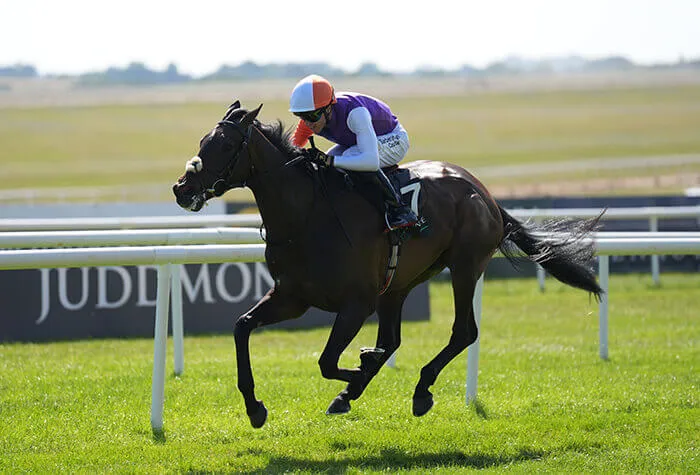 Johanna Walsh and Dylan Browne McMonagle powered to an impressive four-length victory in the Group 1 Juddmonte Irish Oaks.
The handicapping calculations are fairly straightforward: a typical winner of the Irish Oaks in the last decade has been rated 112, a runner-up 110, a third 107, a fourth 103, and a fifth 99. If you crunch the numbers, that gives a figure of 114 on this year’s winner, given the margins, times and field sizes.
That becomes 2 less if you consider the previous achievements of the fillies involved, in a race stripped of the Epsom Oaks winner and original favourite Thundering On.
But I reckon Johanna Walsh deserves the benefit of the higher rating here, even if those she beat were somewhat limited by true Classic standards. Runner-up Inis Mor all but confirmed the form of her third in the French equivalent despite having to wait for a run.
Of course, times require context, always. Saturday’s clocking would not have happened without fairly quick ground and a decent pace. The former can be inferred from the times throughout the card – including a slick 57.35s by COVER UP at 5f – while the latter is confirmed by the sectionals.
As Josh Kerr (the athlete, not the horseracing data analyst) illustrated elsewhere at around the same time on Saturday afternoon, perfect pacing leads to quick times, and Johanna Walsh was not far off perfectly paced.
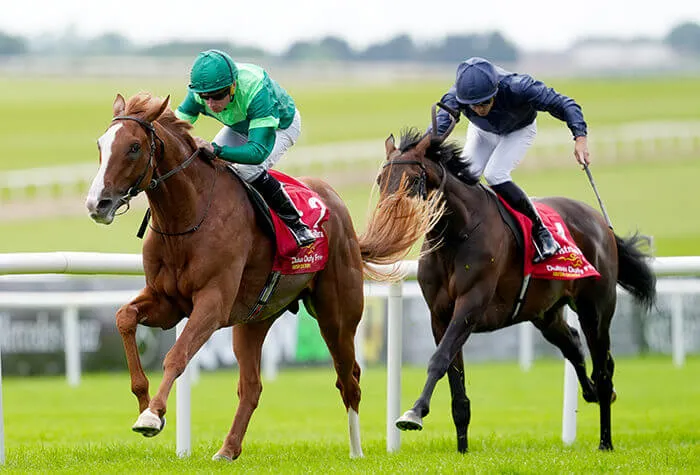 Benvenuto Cellini (R Moore, green cap) won the Irish Derby at the Curragh just three weeks earlier, under similar conditions, hence, recording similar times to Irish Oaks heroine Johanna Walsh.
As it happens, that overall time of hers was remarkably similar to the one recorded by Benvenuto Cellini in a truly run Irish Derby on near-identical ground just under three weeks earlier: 0.16s/a length slower and on just 3 lb quicker ground by my reckoning.
Johanna Walsh was ahead of Benvenuto Cellini until past halfway – though mostly by 1.0s or less – then a bit behind, and was closing the gap again late on, prompting a 105.7% finishing speed compared to the colt’s on-par 103.5%. Quick ground or not, she had to see out the 12f well at the Curragh to win as she did.
Nothing has run since from the Irish Derby, but the form got a collateral shot in the arm earlier in the week when MALTESE CROSS – the runner-up in the Epsom Derby to Christmas Day, who in turn chased home Benvenuto Cellini at the Curragh – won in France.
It was not just any old win, either, but the Group 1 Grand Prix de Paris at Longchamp, in which Maltese Cross did well to prevail at all after a troubled passage.
In a well-run race (race finishing speed of 103.2% compared to par of 102.8%) Maltese Cross got little room for much of the closing stages before surging through the smallest of gaps to lead in the final strides and deny Ancient Egypt, Alam and Varandir.
This is not elite form for the level – only about half a length separated the first four, and they are not all top-class – but it is not bad either. The first two are worth performance ratings of 114, while third and fourth get 113. Maltese Cross himself can be rated 116, in line with a more positive view of what he did at Epsom.
Benvenuto Cellini (rated 122) may be rather better than I initially graded him in other words, but I still do not see him as fully worthy of his elevated position in the betting for Saturday’s King George VI and Queen Elizabeth Stakes (3.35) at Ascot.
I would have Kalpana level with him, Minnie Hauk just ahead of him on her return to 12f, and Calandagan (130) and MASQUERADE BALL (129) comfortably ahead of them all.
Calandagan won this 12 months ago, but arguably his finest hour came when beating Masquerade Ball by a head in the Japan Cup on that one’s home patch in November. The former’s three runs this season have seen him successful at Meydan and Saint-Cloud (between which he got stuck in the mud at Epsom) but neither of those wins rate higher than 120. It is no sure thing that Calandagan is at his very best at present.
Meanwhile, Masquerade Ball’s only run since the Japan Cup was at Hong Kong in April, when he split Romantic Warrior and Sosie. That was at just short of 10f, and Masquerade Ball is probably better around 12f. Sectionals suggest that he should just about have won rather than been beaten a length by one of the world’s best horses.
Looking back further, Masquerade Ball came second in a Japanese Derby and won a Tenno Sho (roughly equivalent to a British Champion Stakes). He is a proper horse, on a light schedule of late compared to his rivals, and I am hopeful that he can score a historic victory at Ascot.
Saturday’s card there also features the Group 3 Princess Margaret (1.45), where some of the very best juvenile filly form is represented by proxy rather than directly. As an example, Alta Regina and Dark Issue are the market leaders despite having finished sixth to VICTORIOUS in the Queen Mary Stakes and fourth to LIBERTANGO in the Albany Stakes respectively on this course last time.
Just behind them is Moonrise, who came second to KING OF CLOUGHAN in the Windsor Castle, also at Royal Ascot. King of Cloughan was back in action last weekend in a disappointingly weak Prix Robert Papin in which he confirmed his rating of 102 in finishing second of three to the top French two-year-old TOKAIDO. The latter is excluded from some races on account of being a gelding.
Let’s take a quick look at the two-year-old picture overall, with Goodwood and other big occasions just around the corner.
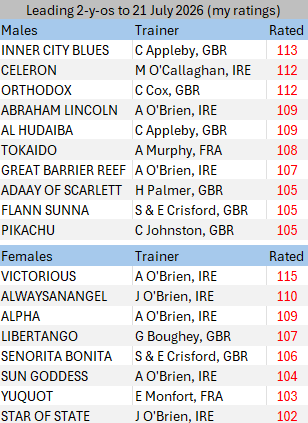
There are first appearances in the lists for CELERON, who left a dud effort at Royal Ascot behind when winning a somewhat shallow Group 2 Railway Stakes at the Curragh on Saturday, and STAR OF STATE who looked every inch a Group performer in the making when running away with the Irish EBF Median Sires Series Maiden at Leopardstown two days earlier.
FLANN SUNNA also gets promoted further on the back of the good subsequent run of the colt who finished a distant third to him at Ascot on 10 July in the Knight Frank Conditions Stakes. The speed he showed there (including a 10.88s for the uphill penultimate 1f) suggests we will be hearing plenty more of him a bit further down the line.